Views: 34 Author: Site Editor Publish Time: 2026-03-22 Origin: Site
Basements are often overlooked, yet they are one of the most humidity-sensitive areas in any home. Many homeowners search for what should basement humidity be after noticing musty smells, condensation, or early signs of mold.
If humidity is not properly controlled, it can lead to structural damage, poor indoor air quality, and health concerns. So what is the ideal basement humidity level, and how can you maintain it year-round?
This guide explains the science behind basement humidity and provides practical, reliable solutions.
Ideal range: 30%–50% Relative Humidity (RH)
Optimal target for most basements: 40%–50% RH
High-risk threshold: Above 60% RH
If you are asking what should basement humidity be, the safest and most widely recommended answer is:
Keep basement humidity between 40% and 50% RH, and avoid levels above 60%.
Maintaining this range significantly reduces the risk of mold growth and moisture-related damage.

Building science and indoor air quality research consistently show that:
Mold growth accelerates when RH exceeds 60%
Dust mites thrive between 50% and 70% RH
Wood absorbs moisture and may warp or swell
Metal components are more prone to corrosion
Keeping humidity below 50% creates a safer and more stable environment.
Basements behave differently from upper floors due to structural and environmental factors.
Basement walls and floors are in constant contact with the ground. This can result in:
Ground moisture migrating through concrete
Vapor diffusion from surrounding soil
Slow but continuous moisture release
Even without visible leaks, moisture can accumulate over time.
Many basements have:
Reduced HVAC coverage
Slower air exchange
Cooler surface temperatures
When warm air enters a cool basement, condensation can form on walls and floors.
Humidity levels can fluctuate throughout the year:
| Season | Common Issue |
|---|---|
| Spring | Increased groundwater and rain |
| Summer | Warm humid air causing condensation |
| Fall | Reduced ventilation |
| Winter | Overly dry indoor air |
This means what should basement humidity be is not just a fixed number, but a target range that may require seasonal adjustment.
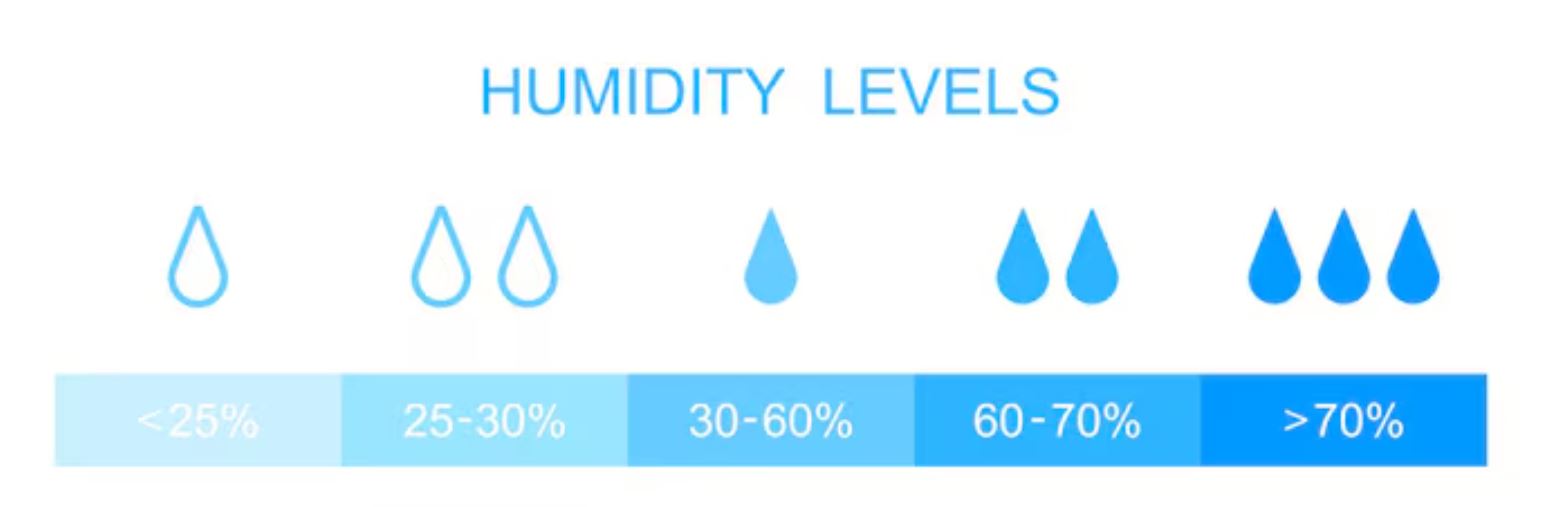
When humidity stays above 55%–60% RH for extended periods, problems can develop.
Mold requires three main conditions:
Moisture
Organic material
Limited airflow
High humidity alone can be enough to trigger growth. Prolonged exposure may contribute to:
Respiratory irritation
Allergy symptoms
Persistent musty odors
Excess moisture can cause:
Wood rot in beams and framing
Warped flooring
Rusted appliances or tools
Deteriorated drywall
Over time, repair costs can far exceed the cost of humidity control.
Basements are often used to store:
Cardboard boxes
Books and documents
Clothing
Furniture
High humidity can lead to mold stains, odor absorption, and material breakdown.
While high humidity is more common, extremely dry air can also cause issues.
If RH drops below 30%:
Wood may shrink or crack
Static electricity increases
Air can feel dry and uncomfortable
Balanced humidity is the goal, not simply the lowest possible level.

For reliable readings:
Choose a digital hygrometer that displays RH
Place it away from direct vents or windows
Monitor readings over several days
Trends are more important than single measurements.
Smart humidity monitors can:
Track data continuously
Send alerts when levels exceed set limits
Integrate with dehumidifiers or HVAC systems
Long-term monitoring helps maintain stability.
Understanding what should basement humidity be is only the first step. The key is consistent control.
If RH exceeds 50%–55%:
Use a properly sized dehumidifier
Ensure proper drainage
Clean filters regularly
Keep doors closed to limit humid air entry
In humid climates, continuous low-level operation may be necessary.
Install exhaust fans if appropriate
Increase controlled air circulation
Avoid opening windows during humid summer weather
Introducing outdoor air is not always beneficial, especially in hot and humid regions.
Repair foundation cracks
Maintain exterior drainage systems
Inspect waterproofing regularly
Structural protection supports long-term moisture control.
If RH falls below 30%:
Add moderate humidity gradually
Avoid overcorrection
Monitor levels consistently
Effective humidity management requires balance rather than extremes.
As an air care manufacturer focused on comfort and health, Smillon emphasizes that humidity control is a system approach. Proper monitoring, seasonal adjustment, and reliable equipment work together to create a healthier indoor environment.

| Season | Recommended RH | Primary Concern | Suggested Action |
|---|---|---|---|
| Spring | 40%–50% | Moisture intrusion | Increase monitoring |
| Summer | 45%–50% | Condensation | Run dehumidifier |
| Fall | 40%–50% | Stagnant air | Maintain airflow |
| Winter | 30%–40% | Overly dry air | Add moderate humidity |
“Keeping windows open solves basement humidity.”
Not necessarily. In summer, it may increase moisture levels.
“No mold smell means no problem.”
Mold can develop behind walls before odors become noticeable.
“Lower humidity is always better.”
Excessively dry air can also damage materials and reduce comfort.
Is 70% humidity too high for a basement?
Yes. Seventy percent RH is well above the safe range and increases mold risk.
Is 40% humidity too low?
No. Forty percent RH is within the ideal range for most basements.
Should I run a dehumidifier year-round?
In humid climates or homes with persistent moisture, continuous operation may be recommended.
Can adding humidity help in winter?
If levels fall below 30%, moderate humidification can improve comfort and protect materials.
So, what should basement humidity be?
Aim for 40%–50% RH
Avoid exceeding 60%
Prevent levels from dropping below 30% in winter
The goal is stable, balanced humidity control throughout the year. With proper monitoring and well-planned air care solutions, your basement can remain a safe, healthy, and usable space long-term.
Looking for a reliable humidity control partner? Reach out at Jelly.wang@smillon.com to discuss tailored solutions.